Best Stock Trading Simulators in 2026
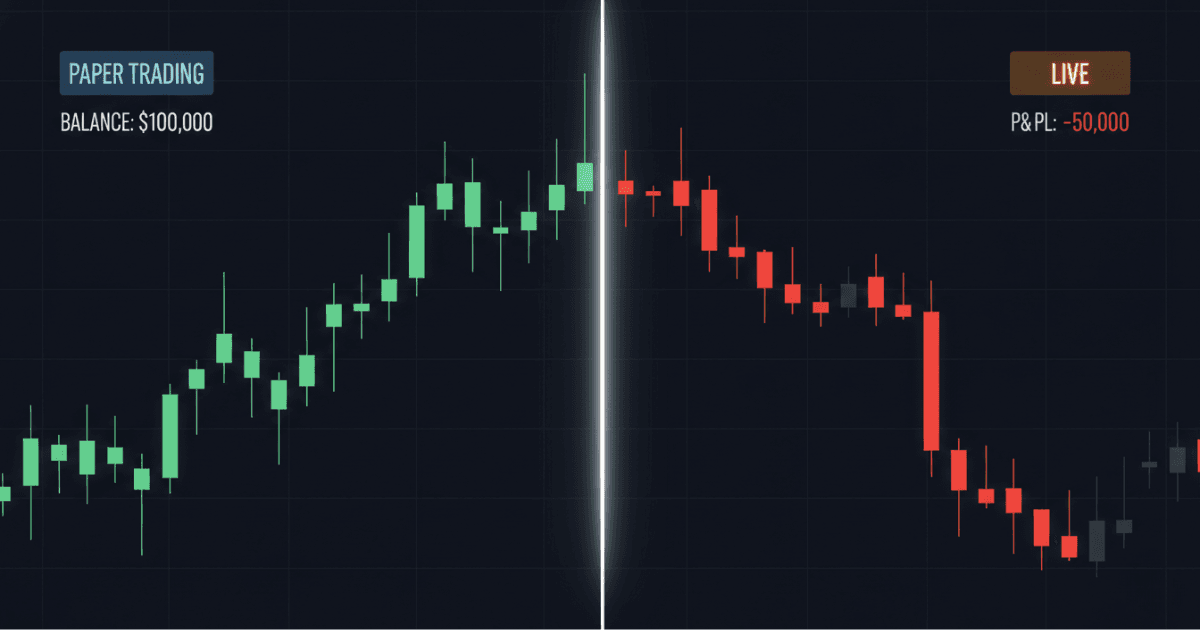
Stock trading simulators let you practice with fake money using real market prices. They're useful, they have real limits, and most roundups don't address either honestly. This guide covers the best simulators available in 2026, what separates a useful one from a toy, and why your paper trading results won't reliably predict how you trade live.
Key Takeaways
- Stock trading simulators let you practice order execution and chart reading with fake money before real capital is on the line.
- No simulator replicates the emotional pressure of a live account — the performance gap between paper and live trading is real and expected.
- thinkorswim paperMoney is the most realistic environment for active traders, but requires a funded Schwab account to unlock real-time data.
- High-repetition practice builds pattern recognition and mechanical fluency; emotional discipline only develops once real money is at stake.
- The PDT rule applies to live margin accounts, not paper accounts — use simulation to understand order mechanics before the $25,000 minimum becomes relevant.
Table of Contents
- What Is a Stock Trading Simulator?
- The One Thing No Simulator Can Fix
- The Best Stock Trading Simulators in 2026
- How to Use a Simulator Without Building Bad Habits
What Is a Stock Trading Simulator?
A stock trading simulator is a platform that lets you buy and sell stocks using virtual money while prices reflect real or near-real market data. You get the interface, the charts, and the order types, without any capital at risk.
The terms "stock simulator" and paper trading are used interchangeably, but there's a practical difference worth knowing. A simulator is often a standalone tool or gamified platform. Paper trading refers to a simulated account built inside a live brokerage, using the same order entry system you'd use with real money. For skill development, the brokerage-based account is stronger, because you're practicing the exact interface you'll trade on live.
The One Thing No Simulator Can Fix
I paper traded for months before opening a live account. My win rate looked decent. My process felt solid. Then I placed my first real trade and understood what I'd missed.
Watching $200 disappear in four minutes is a different experience from watching a simulated balance move. I held trades too long because closing them made the loss permanent. I skipped clean setups because hesitation was suddenly free. The mechanics I'd drilled in simulation were still there, but the emotional weight was something I hadn't prepared for.
That gap is part of why tradicted is built around high-repetition practice. Fast, focused sessions compress your screen time and build pattern recognition through volume. Ericsson, Krampe and Tesch-Römer's research on deliberate practice identified structured repetition as the core mechanism behind expert skill acquisition. A 2024 study published in Nature went further, showing that repetitive practice physically rewires neural pathways, making trained behaviors more automatic and accurate over time.
Reps build the mechanical side. Mark Douglas, in Trading in the Zone, identified why that's not the full picture: trading with no consequences creates emotional detachment that doesn't transfer. You build emotional regulation in a live account, not before it. Simulators are preparation for the mechanics. The psychological pressure has to be earned separately.
The Best Stock Trading Simulators in 2026
Two things separate a useful simulator from a toy: data quality (real-time vs delayed) and order type support (market, limit, stop, stop-limit at minimum). Fill realism matters too — a good simulator executes orders at prices that could have filled in the real market, not just at the mid-price the moment you click.
thinkorswim paperMoney (Schwab)
thinkorswim paperMoney is the most complete paper trading environment available for US retail traders. You get the full thinkorswim platform: advanced charting, options chains, scanners, and custom scripts, with a simulated $100,000 starting balance. Per Schwab's documentation, data defaults to a 20-minute delay unless you link a funded brokerage account, which unlocks real-time quotes.
If you're serious about active trading, that funded account unlock is worth doing. thinkorswim is where most serious retail traders and prop firm candidates do their prep work, and the paperMoney environment mirrors the live platform exactly.
Webull Paper Trading
Webull's paper trading account gives you real-time data without a deposit. The mobile and desktop interfaces mirror the live account, full order types are supported, and you can reset your virtual balance at any point. It's the strongest fully free option available right now.
The charting is solid but doesn't match thinkorswim's depth for serious technical work. For most beginners and intermediate traders, that won't be the constraint.
Moomoo Paper Trading
Moomoo includes Level 2 data in its paper trading environment, which is uncommon at this price point. You get real-time bid/ask depth, access to 63 technical indicators, and options paper trading support. It's the right choice if you're learning to read order flow or want to test an options strategy before putting real capital behind it.
The platform skews toward more advanced users. If you're still working on basic order types, start with Webull and move to Moomoo once the mechanics are solid.
Investopedia Stock Simulator
The Investopedia Stock Simulator is the most beginner-friendly option on this list. It's browser-based, requires no brokerage account, and gives you a $100,000 virtual portfolio with integrated educational content. For a trader who doesn't yet know what a limit order is, it's a reasonable starting point.
Data is delayed, order type support is limited, and fill simulation is simplified. Once you understand the basics, move to a brokerage-based platform.
tastytrade Paper Trading
tastytrade's paper trading environment is built for options. If your goal is to practice covered calls, spreads, or how options pricing behaves through expiration, this is the right platform. The interface mirrors the live tastytrade account, and options mechanics are front and center in a way no other paper environment handles as well.
For straight equity trading, tastytrade isn't the natural home. For options practice, it's the most purpose-built simulator on this list.
Platform Comparison
| Platform | Real-Time Data | Options Support | Order Types | Best For |
|---|---|---|---|---|
| thinkorswim paperMoney | With funded account | Yes | Full | Active traders, serious prep work |
| Webull | Yes | Yes | Full | Free, well-rounded practice |
| Moomoo | Yes (Level 2) | Yes | Full | Order flow, options practice |
| Investopedia Simulator | No (delayed) | No | Basic | Absolute beginners |
| tastytrade | Yes | Yes | Full | Options-focused traders |
| tradicted | Replay-based | No | N/A | Pattern recognition, decision speed |
A Different Tool: tradicted
The five platforms above all work the same way: you open a position, hold it, close it, and move on. That mirrors live trading, which is the point.
tradicted solves a different problem. Beginner traders often have a strategy. The pattern recognition to execute it automatically takes longer to build, and a standard simulator is a slow way to build it. A beginner with a full-time job might see 10 meaningful setups a week sitting in a thinkorswim paper account.
tradicted compresses that. Sessions are short, focused on recognition and decision speed, and stack more reps per hour than a traditional simulator allows. Ericsson, Krampe and Tesch-Römer's deliberate practice research found that structured repetition volume is the primary driver of skill acquisition. tradicted is built on that finding.
I built it, so weigh that accordingly. It doesn't replace brokerage paper trading. You still need time in thinkorswim or Webull to practice order execution in a real-mirror interface. tradicted covers pattern recognition and decision speed. Order entry mechanics belong in thinkorswim or Webull.
How to Use a Simulator Without Building Bad Habits
The biggest mistake traders make in a simulator is treating the fake money like it doesn't matter. A loss that doesn't sting teaches you nothing about managing the next one.
A few rules that keep the practice honest:
- Set a fixed starting balance and don't reset it. Treat drawdowns the way you'd treat real ones. Resetting every time you blow up removes the only feedback the simulation can give you.
- Size every position using real risk rules. If you wouldn't risk more than 1% of your live account on a single trade, apply that rule in simulation too. The habit needs to form before the stakes are real.
- Track every simulated trade in a journal. Write down the entry reason, the stop, the target, and what happened. Building the review habit in simulation means it's automatic by the time real money is involved.
- Understand the PDT rule before you go live. Paper accounts aren't subject to FINRA's Pattern Day Trader rule, so you can day trade freely regardless of balance. The moment you open a live margin account under $25,000, that changes — four or more day trades in a rolling five-business-day period flags your account and locks you out of further day trading until you meet the equity minimum. FINRA filed a proposed rule change in December 2025 to overhaul those provisions, but the rule stands until the SEC completes its review.
- Pick a go-live trigger, not a go-live date. "I'll go live in three months" is arbitrary. "I'll go live when I've followed my process without breaking it for 30 consecutive trading days" is a standard worth meeting.
Traders who struggle in their first live account are rarely underprepared on strategy. The mechanics were there. What wasn't there was any experience of those mechanics under pressure, with real consequences attached to every decision.