A planned 1:3 trade becomes a 1:0.2 trade by the time chasing it feels safe. The target has not moved.
Your entry has, and the stop widens to stay below a level that still means something.
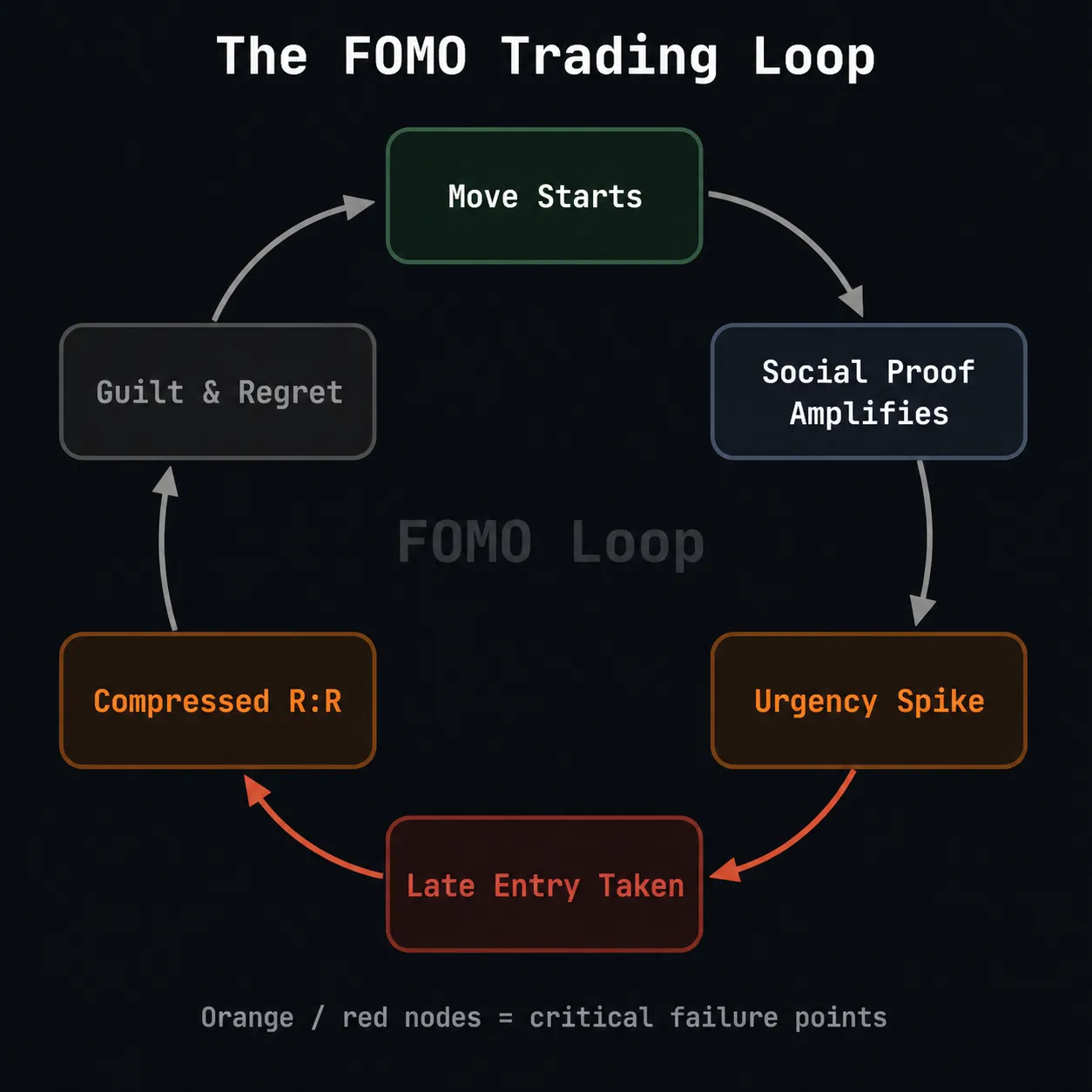
FOMO in trading is the urge that produces that entry. The move is happening, you are not in it, and the criteria you wrote before the open stop applying.
You know the moment. A stock you have been watching is up 12% in 45 minutes, the feed is full of screenshots, and you do not have a position.
Key Takeaways
- FOMO in trading is the urge to enter a trade on urgency alone, bypassing your pre-defined setup criteria.
- Late entries after extended moves compress your available reward and typically force a wider stop, which shrinks or eliminates the edge in the trade.
- Loss aversion, described in Kahneman and Tversky's prospect theory, means the pain of missing a winning trade feels more urgent than the risk of entering a bad one.
- Research from Barber and Odean shows that the most actively trading individual investors underperform the market by 6.5 percentage points annually, a gap driven by overconfidence and excessive turnover.
- A pre-trade checklist, written and reviewed in a cold state before the session opens, is the most direct way to stop a FOMO trade from reaching the order ticket.
Contents
- What Is FOMO in Trading?
- Why Your Brain Is Wired to Chase
- What a FOMO Trade Looks Like
- Planned entry vs FOMO entry, same stock
- Does FOMO Make You Trade More Often?
- How to Stop FOMO Before It Enters the Order Ticket
- One Tool That Removes the Guesswork
What Is FOMO in Trading?
FOMO in trading, fear of missing out, is the anxiety-driven urge to enter a position because a move is happening and you are not in it. The trigger is the sight of price running, other people's gains showing up in your feed, or the feeling that this one might be the move you have been waiting for. A setup never enters it.
The fomo trading meaning is straightforward: you act on urgency, not on criteria. A stock that would not have made your watchlist yesterday suddenly looks compelling at its high of day because it is up 15%.
That shift, from criteria-based decisions to urgency-based decisions, is where FOMO does its damage. The trade might work. But ten more like it, entered the same way, will not produce the same result. If emotional trading shows up across multiple patterns in your sessions, the broader framework in How Emotion Kills Your Trades covers where each one tends to originate.
Why Your Brain Is Wired to Chase
Loss aversion and the cost of missing out
The mechanism behind FOMO is a well-documented cognitive asymmetry.
Kahneman and Tversky's 1979 prospect theory established that losses feel roughly twice as painful as equivalent gains feel good. A $500 loss registers more intensely than a $500 gain registers pleasurably. Your brain weighs them unequally.
Your brain processes a missed winning trade through the same loss-aversion circuitry. The opportunity cost, "I could have made $800 on that," registers as a loss, not as a neutral non-event. That perceived loss creates urgency, and urgency pushes you to buy something extended to relieve the feeling of being left out.
Loss aversion is a feature of how human cognition handles uncertain outcomes, not a character defect. A 2014 analysis of 28.5 million real trades by 81,300 live traders found clear evidence of loss-aversion behavior consistent with prospect theory. The pattern holds outside lab settings.
Overconfidence and the attention trap
A second mechanism runs underneath FOMO: attention bias combined with overconfidence.
A stock that spikes and fills your feed pulls your attention toward it. Everything about it feels urgent. Barber and Odean's 2011 review of individual investor behavior documents that retail traders are heavily influenced by attention-grabbing events, including news, volume spikes, and extreme returns, when making buy decisions. The stocks that shout loudest are the ones that get bought, regardless of setup quality.
Once you lock onto a trade like that, overconfidence pushes the decision faster. You feel like you can read the momentum, and the move seems obvious in hindsight. That makes the next move feel predictable, even when the R:R math on the entry says otherwise. By the time you run the R:R numbers, you have clicked buy.
What a FOMO Trade Looks Like
The math of the late entry
The problem with FOMO entries is arithmetic.
Say you identified a stock at $50.00 with a planned entry on a breakout of a consolidation zone. Your stop sits at $48.00, two dollars below the entry. Your target is $56.00. That is a 1:3 risk-to-reward ratio: you risk $2.00 to make $6.00.
You miss the entry. The stock moves without you. You watch it run to $55.50. The feed is lit up. You buy at $55.50.
The target has not changed: $56.00 is still $56.00. You now have $0.50 of reward left. Your stop has to sit somewhere logical, maybe $53.00 below recent support, which puts your risk at $2.50. The trade that had a 1:3 setup now has a 1:0.2 setup. You are risking $2.50 to make $0.50.
Planned entry vs FOMO entry, same stock
Both rows below are the same ticker on the same day, with the same target. Only the entry moved.
| Planned trade | FOMO trade | |
|---|---|---|
| Entry | $50.00 | $55.50 |
| Stop | $48.00 | $53.00 |
| Target | $56.00 | $56.00 |
| Risk per share | $2.00 | $2.50 |
| Reward per share | $6.00 | $0.50 |
| Risk-to-reward | 1:3 | 1:0.2 |
Waiting cost $5.50 of entry price and bought $0.50 of remaining reward.
A strategy built on 1:0.2 trades has negative expectancy. A 90% win rate cannot save it.
Does FOMO Make You Trade More Often?
Yes, and that frequency has a documented cost.
What the overtrading research measured
Barber and Odean's 2000 study tracked 66,465 household accounts at a large discount broker from 1991 to 1996. The most active traders earned an annual return of 11.4% while the market returned 17.9%, a 6.5 percentage-point gap. Households that traded infrequently earned 18.5% over the same period.
The authors state the mechanism directly:
Overconfidence can explain high trading levels and the resulting poor performance of individual investors. Our central message is that trading is hazardous to your wealth.
Brad M. Barber and Terrance Odean, Trading Is Hazardous to Your Wealth: The Common Stock Investment Performance of Individual Investors, The Journal of Finance, Vol. LV, No. 2, April 2000
The 2001 follow-up, Boys Will Be Boys, found that men traded 45% more than women, and that excess trading reduced men's net returns by 2.65 percentage points per year. Overconfident traders take more trades, and more trades mean more transaction drag and more bad entries.
A 2024 study in Behavioral Sciences examining student traders found financial FOMO was significantly associated with stock market and crypto trading participation and problem gambling severity. The student sample limits how far you can generalize, but the direction matches the Barber and Odean overtrading data.
A session that starts with one chased entry tends to produce a second. You have broken the pre-defined criteria once and the rules are now negotiable. That is what pushes a two-trade day into a six-trade day and turns a manageable loss into a daily loss limit breach. That pattern is overtrading, and FOMO is one of its most common starting points.
How to Stop FOMO Before It Enters the Order Ticket
FOMO trades start the moment you begin negotiating with your criteria, before the order ticket opens.
Mark Douglas in Trading in the Zone frames the fix in terms of probability thinking: accept that any single trade outcome is random within a larger distribution, and the urgency behind any individual setup dissolves. You are not missing the trade. You are missing a trade, one of many that will appear if you stay process-consistent.
The practical version is a pre-trade checklist.
Write the conditions your trade must meet before the session opens, in a cold state, away from live price action. Then run every potential trade against that list before touching the order ticket. If the checklist says no, the trade does not happen.
Brett Steenbarger's The Psychology of Trading identifies the cold-state/hot-state distinction as the core behavioral lever in trading performance. Rules written in a cold state are the only rules that hold in a hot state. FOMO cannot be reasoned with in real time. It can only be blocked by criteria you set before the session.
What goes on a pre-trade FOMO checklist
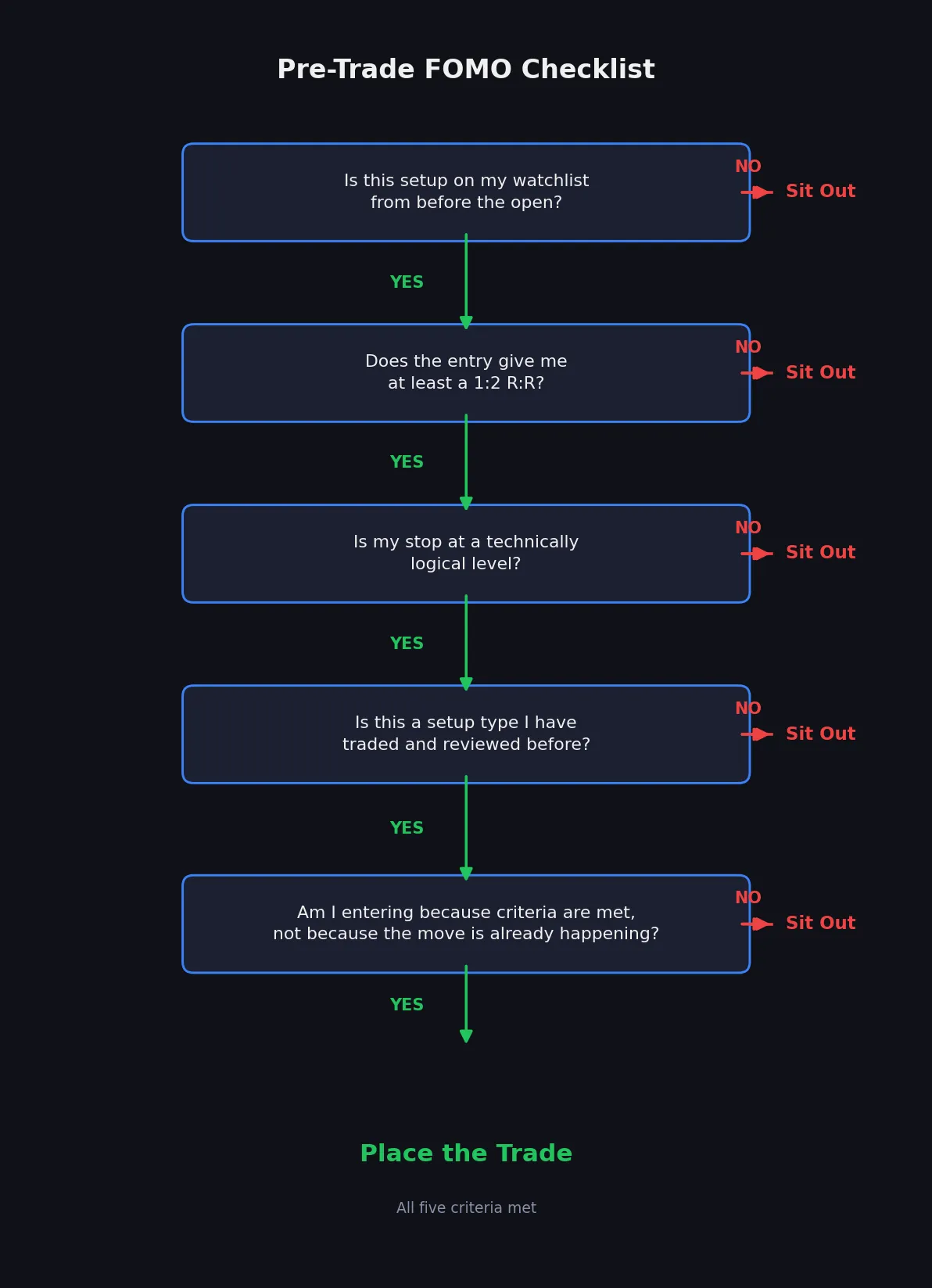
Five questions, answered before the order ticket opens:
- Is this setup on my watchlist from before the open?
- Does the entry price give me at least a 1:2 risk-to-reward ratio?
- Is my stop placed at a technically logical level, not a dollar amount I am comfortable losing?
- Is this a setup type I have traded and reviewed before?
- Am I entering because the criteria are met, or because the move is happening and I am not in it?
If the last question gets an honest answer of "the move is happening and I am not in it," the trade does not meet the criteria.
One Tool That Removes the Guesswork
The fastest way to stop a FOMO impulse is to run the numbers on the entry you are about to take.
FOMO trades feel strong because the momentum is real. Momentum does not change the R:R math. Plugging your actual entry, stop, and target into a risk-reward calculator gives you the honest version of the trade, not the version urgency is selling you.
Use the Risk Reward Calculator before you place any trade you did not have on your pre-session list. Enter where you are thinking of getting in, where your stop realistically needs to sit, and where your target is. If the R:R comes back below 1:2, the trade does not meet the minimum standard, regardless of how strong the chart looks.
That 30-second check forces one cold-state number into the middle of a hot-state moment. Pull up the calculator, enter your real entry, stop, and target, and the trade either meets 1:2 or it does not go on.