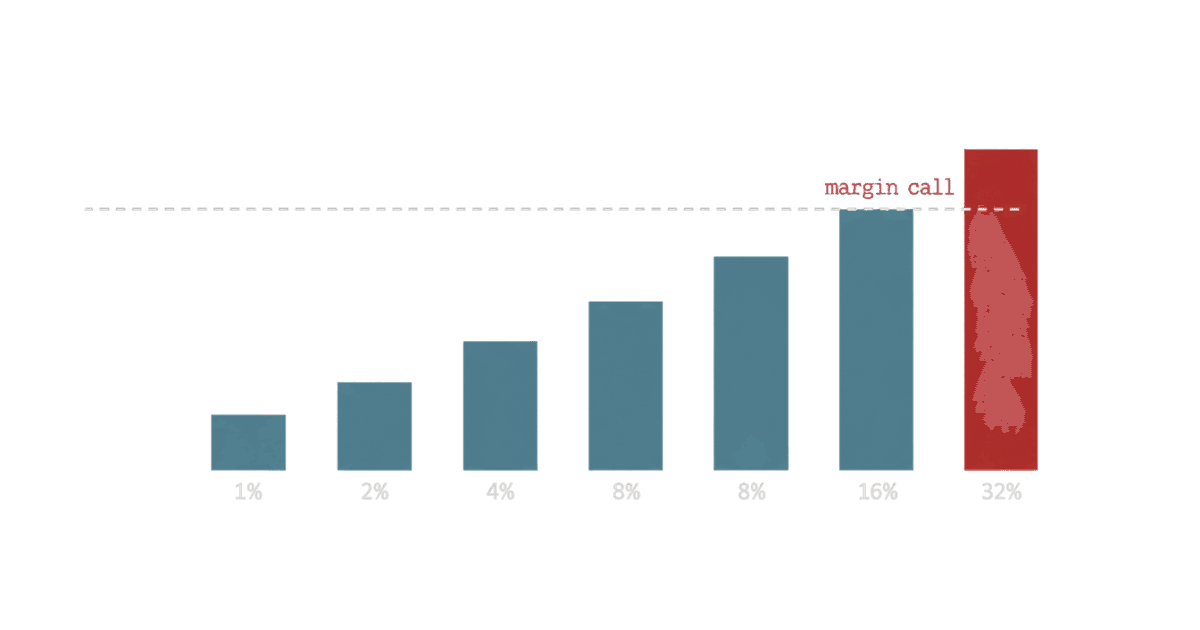
The martingale strategy has one premise: double your position size after every losing trade, and the first win covers all previous losses plus a small profit. The math is clean. In a live $25,000 trading account, starting at 1% risk per trade, seven consecutive losses wipe it out. Seven-loss streaks are a routine feature of most trading strategies. The strategy fails in trading for the same reason it fails at a casino: finite capital meets a doubling sequence, and the capital runs out first.
Key Takeaways
- The martingale strategy doubles position size after every loss, meaning a short streak of bad trades can wipe a significant portion of any finite account.
- It doesn't improve expected value. A negative-edge setup produces a larger expected loss when you double the position, not a smaller one.
- In stock trading, positions can gap down overnight or trend against you for days, and there's no built-in mean reversion to bail you out.
- FINRA Rule 4210 sets a 25% maintenance margin floor, so a margin account receives a margin call well before you reach zero, cutting the doubling sequence short at the worst possible moment.
- The anti-martingale approach inverts the logic: increase size after wins, reduce after losses, which aligns sizing with positive expectancy rather than fighting it.
Table of Contents
- What the Martingale Strategy Is
- The Math That Breaks It
- Why Stocks Are Worse Than a Roulette Wheel
- The Anti-Martingale Approach
- What to Use Instead
What the Martingale Strategy Is
The system originated in 18th-century French gambling halls, applied to coin-flip games with near-50/50 odds. You bet $1. You lose. You bet $2. You lose again. You bet $4. The first win recovers every previous loss and leaves you with your original $1 profit. The bet is that a losing streak can't go on forever.
Traders imported the concept directly into stock markets. You buy 100 shares at $50. The price drops to $48; you buy 200 more. It drops to $46; you buy 400. When the stock recovers to your average cost, you close the position flat or with a small gain.
The Doubling Mechanic
Each loss triggers a position that is double the previous one in dollar size. The profit on that larger winning position exceeds the sum of all prior losses because each doubling step is larger than the cumulative total before it.
That arithmetic holds only when two conditions are met: unlimited capital, and a price that will eventually reverse. In a live trading account, neither condition exists.
Why It Feels Logical
Loss aversion drives it. Kahneman and Tversky's prospect theory research showed that traders feel losses roughly twice as intensely as gains of the same size. Adding to a losing position feels like taking control rather than accepting a loss.
That's the same psychological driver behind emotional trading. Martingale just gives it a formula to hide behind.
The Math That Breaks It
A statistical analysis published by the UNLV Gaming Institute confirmed what probability theory establishes: the expected value of each trade is unchanged regardless of how you sequence position sizes. A setup with negative edge produces a larger expected loss when the position is doubled. The math doesn't adjust for recent losing streaks.
The losses compound in exponential steps. Start risking 1% of a $25,000 account on the first trade and double after each loss.
The Blowup Table
| Starting Risk | Losses to 25% Drawdown | Losses to 50% Drawdown | Losses to Blow Account |
|---|---|---|---|
| 0.5% | 6 | 7 | 8 |
| 1% | 5 | 6 | 7 |
| 2% | 4 | 5 | 6 |
Starting at 1%, seven consecutive losing trades wipe a $25,000 account. Six losses puts cumulative losses at roughly 63% of starting capital. Traders who backtest martingale on a simulator usually run it through periods where streaks that long never appear in the data sample, but a run of six to ten consecutive losses is a normal feature of most trading strategies, not a statistical outlier.
Pozdnyakov's 2025 formal analysis of the gambler's ruin problem provides the closed-form proof: given finite capital and any zero or negative edge, the probability of eventual account ruin approaches 1 as the number of trades increases. Run it long enough and every account hits the same wall.
Why Stocks Are Worse Than a Roulette Wheel
A roulette wheel resets between spins, with no memory of the previous result. A stock in a downtrend carries that momentum forward. Every doubling attempt adds size to a position moving against you, not to a setup resetting toward neutral.
Stocks can also gap down overnight. A company closing at $50 can open at $35 the next morning after an earnings miss or a regulatory filing. That single gap skips two or three rungs on the doubling ladder simultaneously, pushing losses from manageable to catastrophic before the NYSE opens at 9:30 AM EST. Assuming a declining stock will return to your entry price on schedule is one of the patterns Barber and Odean's research on individual investor behavior identified as a consistent driver of retail account losses, and among the most common beginner mistakes documented across retail trading populations.
Stocks Don't Mean-Revert on Demand
Mean reversion exists in markets. It doesn't operate on a timeline that benefits a trader doubling a distressed position. Lehman Brothers never recovered. A trader who doubled into that name on the way down didn't take one bad trade. Every subsequent position was larger, converting a recoverable drawdown into a total loss.
A stock that drops 20% from your entry can drop another 40% after that. Roulette spins are independent. The next day's price action on a trending stock is not.
The Margin Account Problem
Most retail traders using leverage operate in a margin account, which means FINRA Rule 4210 applies. The rule sets a minimum 25% maintenance margin requirement on long stock positions. A broker issues a margin call when account equity drops below that threshold. At that point you either deposit additional funds or the broker liquidates at whatever price is available.
On a $25,000 account, that call arrives at roughly $6,250 in losses, not at zero. The doubling sequence gets cut off at exactly the point where the system's own math would demand the recovery trade. Nerve has nothing to do with it.
The Anti-Martingale Approach
The anti-martingale strategy inverts the core mechanic: after a winning trade, you increase position size; after a losing one, you reduce it. Larger capital goes to work when trading is going well, smaller positions limit damage when it isn't.
This aligns sizing with how trading edge accumulates in practice. Winning streaks tend to cluster when market conditions match your setup criteria. Losing streaks tend to cluster when they don't. Scaling up on winners compounds favorable conditions, and pulling back during losing streaks keeps the damage from snowballing.
How It Works
A basic anti-martingale approach starts at 1% risk per trade. After three consecutive wins, the trader increases to 1.5%. After any loss, it drops back to 1%. The exact scaling ratios depend on your system and variance tolerance, but the principle holds: you increase exposure when the account is growing and reduce it when trades are going wrong.
Van Tharp's position sizing research flags martingale as a method that produces ruin regardless of the quality of the underlying trading system. Anti-martingale sizing allows a positive-expectancy system to compound without a built-in blowup sequence.
Martingale vs. Anti-Martingale
| Factor | Martingale | Anti-Martingale |
|---|---|---|
| Size after a loss | Doubles | Reduces |
| Size after a win | Resets to original | Increases |
| Effect on drawdown | Accelerates losses | Limits losses |
| Edge requirement | Assumes mean reversion | Requires positive expectancy |
| Margin call risk | High | Low |
| Suited to | No retail trader with finite capital | Traders with a verified edge |
What to Use Instead
Fixed fractional position sizing is the standard approach used across professional trading operations and documented extensively in Van Tharp's Definitive Guide to Position Sizing Strategies. You risk a fixed percentage of current account equity on every trade, regardless of recent results. The typical range for retail traders is 0.5% to 2% per trade.
If your account is $25,000 and you risk 1%, your maximum loss per trade is $250. After a $2,500 drawdown, the account sits at $22,500 and your 1% risk drops to $225. Position sizes shrink automatically during losing streaks, which prevents the acceleration into a blowup sequence. This approach works alongside your risk-to-reward ratio: size the position to your stop level, not to a recovery target.
Fixed Fractional Sizing
The core advantage of fixed fractional sizing is survivability. A ten-trade losing streak at 1% fixed fractional costs roughly $2,390 on a $25,000 account. You're still trading.
To use it reliably, you need to track your trades with enough detail to know your realized risk per trade, not just the intended risk at entry. Slippage and overnight gaps mean actual losses sometimes exceed planned stops, and that difference accumulates unless you're recording each trade with the actual exit price, not the planned stop.
The Kelly Criterion
The Kelly Criterion, developed by John Kelly at Bell Labs in 1956, adds win rate and average win/loss ratio to the sizing calculation. The formula identifies the theoretically optimal fraction of capital to risk for maximum long-run account growth:
$$f^* = \frac{bp - q}{b}$$
Where b is the ratio of average win to average loss, p is your win rate, and q is your loss rate (1 − p). Feed in real numbers from your trade history and the formula gives you the upper bound on sizing that supports long-run growth.
Most traders use a half Kelly or quarter Kelly in practice. Full Kelly sizing produces drawdowns that are psychologically difficult to hold through, even when the math behind it is correct. The prerequisite is the same as fixed fractional: a positive-expectancy system has to exist before position sizing does any useful work. Sizing a negative-edge system more precisely doesn't save it.