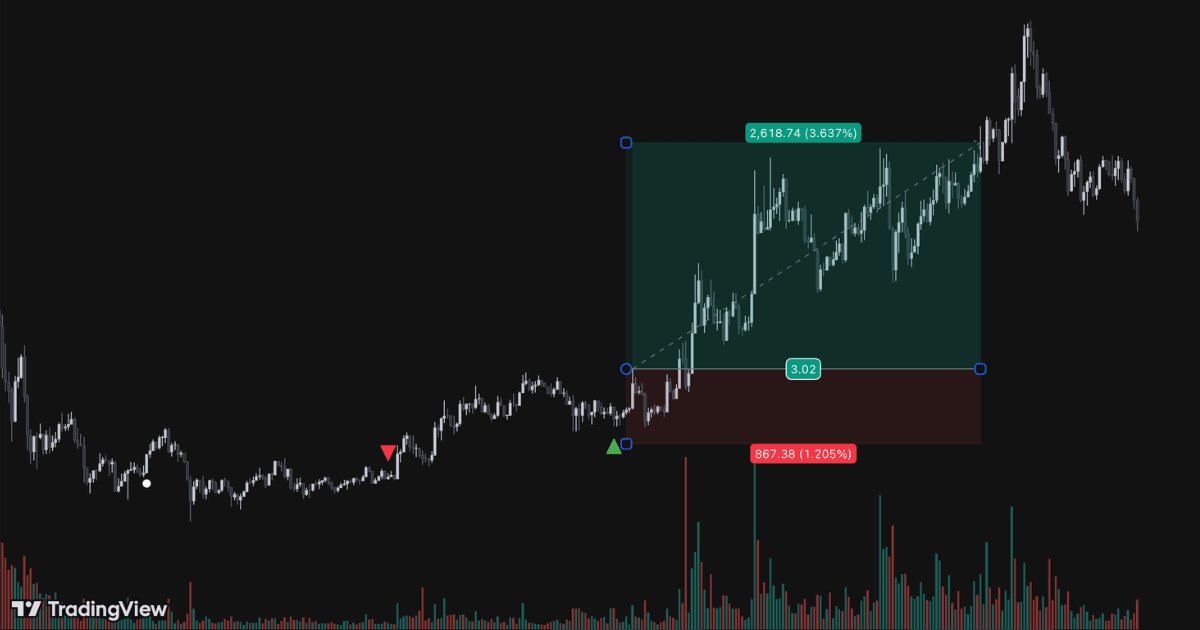
The risk-to-reward ratio compares how much you're willing to lose on a trade to how much you stand to make if it works out. You calculate it before you enter, using your stop-loss and your target. It's one of the simplest numbers in trading and one of the most ignored.
Key Takeaways
- The risk-to-reward ratio compares how much you stand to lose if you're wrong to how much you stand to gain if you're right, calculated before the trade using your stop-loss and target levels.
- A ratio where reward is at least twice the risk gives your results a statistical buffer when your win rate drops, as it inevitably will.
- Risk-to-reward ratio alone doesn't determine profitability; expectancy combines it with win rate to show whether a strategy makes money over a large sample of trades.
- Barber and Odean found that individual investors who traded most heavily underperformed the market by approximately 6.5 percentage points annually, a gap driven largely by poor trade selection and uncontrolled risk.
- Tracking your trades in R-multiples over time reveals whether your actual expectancy matches the theoretical ratio you calculated before each trade.
Table of Contents
- How to Calculate the Risk-to-Reward Ratio
- Why Win Rate Changes Everything
- What "Good" Looks Like
- How to Use It Before You Enter a Trade
- The Mistakes That Make It Useless
How to Calculate the Risk-to-Reward Ratio
The Formula
Risk-to-reward ratio = potential loss ÷ potential gain.
Three inputs: your entry price, your stop-loss level, and your target. From those you get two distances, one in each direction, and you compare them as a ratio.
If potential reward is larger than potential risk, the ratio expressed as risk:reward will be less than 1:1. A 1:2 ratio means you're risking one unit to target two. A 1:3 means you're risking one to target three. When the ratio flips, say 2:1, you're risking more than you stand to make. That's a setup most structured traders pass on.
A Worked Example
Say you're buying a NYSE-listed stock at $50.
- Stop-loss: $45 (risk = $5 per share)
- Target: $65 (reward = $15 per share)
- Risk-to-reward: $5 ÷ $15 = 1:3
Now compare that to a different setup at the same entry where the target is only $55.
- Stop-loss: $45 (risk = $5 per share)
- Target: $55 (reward = $5 per share)
- Risk-to-reward: $5 ÷ $5 = 1:1
Both entries look identical on the chart. The first setup gives you three times the breathing room.
Why Win Rate Changes Everything
Risk-to-reward ratio doesn't tell you whether a strategy is profitable on its own. It's one input into a bigger calculation called expectancy, which is the average amount you make or lose per trade over a large sample. Expectancy uses your win rate, your average win size, and your average loss size together.
Research by Barber and Odean found that the most active individual investors underperformed the market by approximately 6.5 percentage points annually. The traders who churned their accounts the most, taking trade after trade without a consistent edge or risk framework, paid the steepest price.
Here's why the combination of win rate and R/R matters more than either number in isolation:
| Win Rate | Risk-to-Reward | Avg Win | Avg Loss | Expectancy per Trade |
|---|---|---|---|---|
| 40% | 1:3 | 3R | 1R | +0.60R |
| 40% | 1:2 | 2R | 1R | +0.20R |
| 40% | 1:1 | 1R | 1R | −0.20R |
| 50% | 1:2 | 2R | 1R | +0.50R |
| 50% | 1:1 | 1R | 1R | 0.00R |
| 60% | 1:1 | 1R | 1R | +0.20R |
Expectancy = (win rate × avg win) − (loss rate × avg loss). Values expressed in R per trade.
A trader winning 40% of trades still profits with a strong enough ratio. A trader winning 60% can still break even if they're taking 1:1 setups. The ratio and the win rate have to work together.
What "Good" Looks Like
Most trading education sources suggest a minimum reward-to-risk ratio of 2:1, meaning your target should be at least twice as far from entry as your stop. That's a sensible starting point, not a universal rule.
"Good" depends on your actual win rate. A scalper taking high-probability setups on a liquid stock might run a 1.5:1 reward-to-risk ratio with a 65% win rate and be consistently profitable. A swing trader taking fewer trades might need 1:3 or better to stay positive through drawdowns between setups.
The right ratio is the one that, combined with your real win rate, produces positive expectancy. You find that number in your trading journal.
How to Use It Before You Enter a Trade
Setting Your Stop and Target
The ratio is only as clean as the inputs. Your stop-loss shouldn't be a random distance from entry. It should sit at a logical level where the reason for being in the trade no longer holds, typically below a key support and resistance level or outside a clear price structure.
Once the stop is placed, calculate the distance in dollars or points. That's your risk. Then set a realistic target based on where the trade genuinely has room to run, not where you'd like the price to go. Divide risk into reward. If the result doesn't meet your minimum, the setup doesn't qualify.
Don't adjust the stop to manufacture a better-looking ratio. That's the most common way traders fool themselves.
R-Multiples and Position Sizing
Once you have a risk distance in price terms, you can convert it into a dollar risk by sizing the position. If you risk 1% of a $20,000 account per trade, your max loss is $200. That's 1R.
If your stop sits $5 per share below entry, you buy 40 shares ($200 ÷ $5). Your position size comes from the risk, not the other way around.
Expressing every trade result as an R-multiple standardizes performance across different stocks and instruments. A +3R win and a −1R loss mean the same thing whether the stock was $15 or $150. What changes is the position size. Track enough trades in R-multiples and your real expectancy becomes visible in the data.
The Mistakes That Make It Useless
Ignoring the ratio entirely is one of the most consistent patterns in retail trading data. But there are subtler errors that are just as damaging.
Moving the stop after entry. You accept a 1:3 setup, the trade goes against you, and instead of letting the stop do its job you move it down "just a little." The loss you take is now bigger than the one you budgeted. Your actual R/R on that trade is no longer 1:3.
Calculating the ratio but ignoring your real win rate. A 1:5 ratio looks impressive. If you hit your target 10% of the time, the expectancy is deeply negative.
Taking any setup that clears the minimum ratio. Not every 1:2 setup is worth taking. The ratio is a filter, not a signal. The underlying reason for the trade still has to be sound.
Letting emotion override the exit plan. A predefined R/R removes the emotional decision-making from the trade by telling you exactly where you're wrong and exactly where you're right before price gets there. That only works if you respect the levels.
Barber and Odean's data on retail underperformance wasn't about bad luck or bad markets. It was the accumulated cost of traders who sized positions without a plan, closed winners early, and let losers run past every sensible exit point.