The stock market isn't complicated. It's a place where buyers and sellers agree on a price for a piece of a business. Most beginners trip up on what happens inside their head when the price moves against them with real money on the line.
Key Takeaways
- The stock market is a network of exchanges where buyers and sellers trade shares of publicly listed companies. The NYSE and Nasdaq are the two primary US exchanges.
- Owning a stock means owning a fractional share of a real business, which entitles you to a portion of its earnings and, in most cases, voting rights on company decisions.
- Stock prices move because of supply and demand. More buyers than sellers pushes prices up. More sellers than buyers pushes prices down.
- The S&P 500 has returned roughly 10% annually over the long run, but individual years swing dramatically: 2022 was −18.1%, 2024 was +25.0%.
- Most beginner losses come from behavior, not ignorance of mechanics. Trading too often, chasing momentum, and panic-selling during drawdowns account for the bulk of underperformance documented in retail trader research.
Table of Contents
- What Is the Stock Market?
- What Does Owning a Stock Actually Mean?
- How Does the Stock Market Work?
- Bull Markets and Bear Markets
- How Do You Actually Make Money From Stocks?
- What Beginners Usually Get Wrong
- How to Buy Your First Stock
- Stock Market Terms Every Beginner Should Know
What Is the Stock Market?
The stock market is a network of exchanges and trading venues where investors buy and sell shares of publicly listed companies. In the US, the Securities and Exchange Commission (SEC) describes it as a way for companies to raise capital from the public and for investors to share in a company's growth and income. When someone says "the market was up today," they're almost always referring to a major index: the S&P 500, the Dow Jones Industrial Average, or the Nasdaq Composite. That doesn't mean every stock moved in the same direction.
There are roughly 4,000 publicly traded companies in the US. Not all of them move together, and the index is a weighted average of a selected group. Your portfolio and "the market" are not the same thing.
Primary market vs. secondary market
The stock market has two distinct layers. The primary market is where a company issues shares to the public for the first time: an initial public offering, or IPO. Investors buy directly from the company, and the company receives the proceeds. The SEC's Investor.gov outlines this as the mechanism through which businesses access public capital.
Once those shares are issued, all subsequent trading happens on the secondary market: the exchanges most people picture when they think of the stock market. No money goes back to the company when you buy Apple stock from another investor on the NYSE. You're buying from a seller, not from Apple.
What Does Owning a Stock Actually Mean?
A stock is a type of security that gives you a fractional ownership stake in a company. According to the Securities and Exchange Commission (SEC), stockholders are entitled to a proportional share of the company's assets and earnings. On common stock, the type most retail investors buy, that includes voting rights on major company decisions like board elections and mergers.
Owning 10 shares of a company with 1,000,000 total shares outstanding means you own 0.001% of that business. You're a part-owner: not a lender, not a customer. If the business does well over time, the value of your stake rises. If it fails, you can lose everything you put in.
Common stock vs. preferred stock
Most stock market conversations are about common stock. It carries voting rights and the potential for capital appreciation. Preferred stock works differently. It pays a fixed dividend and has priority over common stockholders if the company is liquidated, but it carries no voting rights and behaves more like a bond than a stock. The Financial Industry Regulatory Authority (FINRA) covers both classes as distinct instruments with different risk profiles. Most beginners will only ever deal in common stock.
How dividends work
Some companies distribute a portion of their profits to shareholders as dividends, paid quarterly in cash. Not all stocks pay dividends. Growth-oriented companies like Amazon have historically reinvested earnings back into the business rather than distributing them. Dividend-paying stocks tend to be more mature, established businesses: utilities, consumer staples, large financials. You don't need to do anything to receive a dividend. It is credited to your brokerage account on the payment date.
How Does the Stock Market Work?
When you place a buy order through your broker, that order routes to an exchange where it's matched with a seller willing to accept your price. The exchange acts as the venue and the enforcer of trade rules. It does not own the stock. It facilitates the transaction. The SEC's Trading Basics guide describes this process as a continuous auction where millions of orders interact electronically.
How stock prices are determined
Price comes down to supply and demand. If more investors want to buy a stock than sell it, the price rises. If sellers outnumber buyers, it falls. Every stock has a bid price (what buyers are willing to pay) and an ask price (what sellers want). The difference between them is the spread. When you hit "buy" on your brokerage app, you're accepting the ask price. When you sell, you're accepting the bid.
Companies don't control their stock price after the IPO. It reflects what investors collectively believe the business is worth at any given moment, and that belief shifts as earnings reports land, economic data comes in, interest rates move, and sentiment swings.
NYSE and Nasdaq: not the same thing
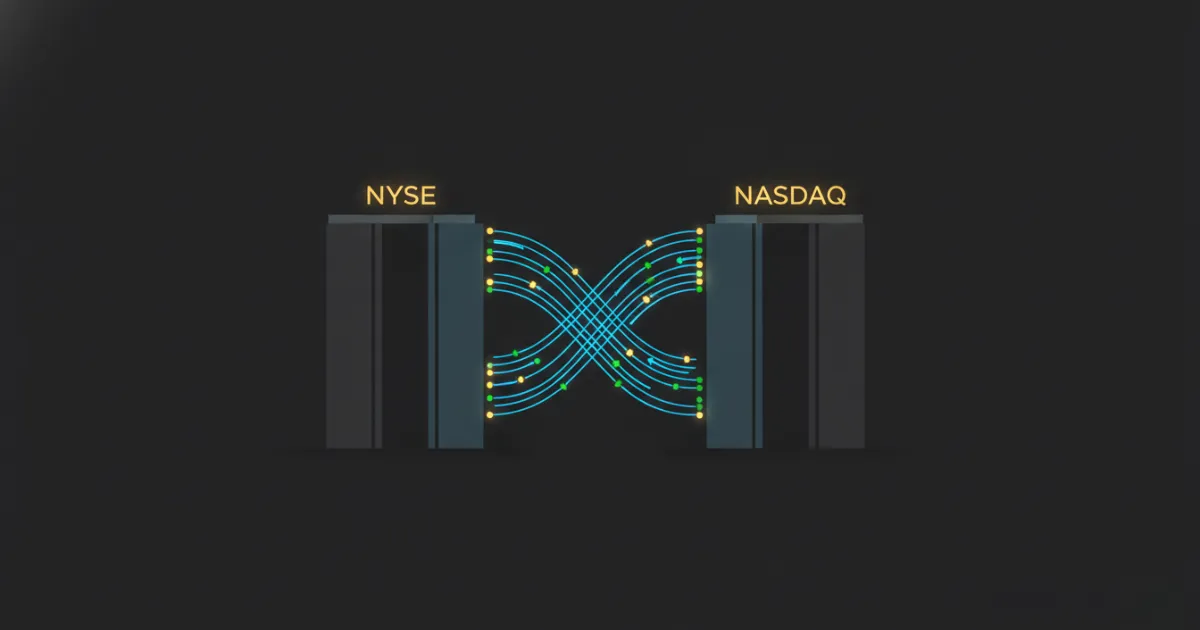
The two main US exchanges operate differently. The NYSE uses a hybrid auction model: at the open and close each day, a designated market maker facilitates an auction that sets the opening and closing price. The Nasdaq is fully electronic, with no trading floor, matching orders through an automated system.
| Feature | NYSE | Nasdaq |
|---|---|---|
| Trading model | Hybrid auction + electronic | Fully electronic |
| Trading floor | Yes (New York City) | No |
| Known for | Blue-chip industrials, financials | Technology, growth companies |
| Market cap (approx.) | Largest by total listed value | Second largest |
| Index associated | Dow Jones Industrial Average | Nasdaq Composite |
Both are regulated by the SEC and FINRA. The exchange a stock lists on doesn't affect how you trade it. Your broker handles the routing.
Bull Markets and Bear Markets
A bull market is a sustained period of rising prices, defined as a gain of 20% or more from a recent low. A bear market is the reverse: a decline of 20% or more from a recent high. You'll only know you've been in a bear market once the index has already dropped 20%, which means significant damage is done before the label applies.
Bull markets have lasted longer than bear markets on average, but bear markets tend to be sharper, faster, and more emotionally punishing than the averages suggest. A 50% drawdown requires a 100% gain to get back to even. That asymmetry is why position sizing and diversification matter even when your only plan is to buy and hold.
How Do You Actually Make Money From Stocks?
Two mechanisms: capital gains and dividends.
Capital gains come from selling a stock for more than you paid. If you buy 10 shares at $50 and sell at $75, your capital gain is $250. Short-term gains (held under one year) are taxed as ordinary income. Long-term gains (held over one year) qualify for lower tax rates, currently 0%, 15%, or 20% depending on your taxable income. The IRS wash sale rule disallows a tax loss if you repurchase the same or substantially identical security within 30 days before or after the sale.
Dividends are the second path. A company paying a 2% annual dividend yield on a stock priced at $100 distributes $2 per share per year, in quarterly installments of $0.50. Reinvest those dividends and they compound over time.
The S&P 500 has returned roughly 10% annually over the long run when total returns (price appreciation plus reinvested dividends) are measured. That number masks enormous year-to-year variation: 2022 returned −18.1%, 2024 returned +25.0%. A decade of patience absorbs those swings. A 12-month horizon doesn't.
What Beginners Usually Get Wrong
The mechanics of the stock market take about an afternoon to understand. The behavioral side takes years, and most people never close the gap.
Research from Barber and Odean, drawing on trading data from tens of thousands of individual investors, found that retail investors trade too often and underperform market indexes as a result. Transaction costs, taxes, and the tendency to sell winners too early and hold losers too long are the primary culprits. None of those are knowledge problems. They're behavioral ones.
The second mistake is confusing "the market went up" with "my stocks went up." They're only the same thing if you own a broad index fund. Individual stocks can drop 40% while the S&P 500 hits all-time highs. Reading about why most beginners lose money before you open an account is worth the 10 minutes.
The third mistake is conflating long-term investing with short-term trading. Buying and holding a diversified portfolio is not the same activity as trading individual stocks around catalysts and price levels. They require different skills, different time commitments, and different psychological tolerances. Most people who say they want to "trade stocks" mean something closer to long-term investing, and they'd do better to start there.
How to Buy Your First Stock
Step 1: open a brokerage account
You'll need a brokerage account to buy stocks. The major US online brokers, Schwab, Fidelity, Interactive Brokers, and others, all offer commission-free stock trading with no account minimum. A cash account requires you to trade with funds you've deposited. A margin account lets you borrow from the broker against your holdings. For beginners, a cash account is simpler and carries less risk.
Step 2: fund the account and choose what to buy
Transfer money from your bank to the brokerage. Most transfers settle in 1-3 business days. Before choosing a stock, decide whether you're selecting individual companies or buying a broad index fund or ETF: a basket of stocks that tracks an index like the S&P 500. FINRA notes that new investors should consider diversification rather than concentrating capital in a single stock. Most professionals would agree that starting with a broad ETF is a better introduction than picking individual companies cold. Consider paper trading first, with the practice balance set to what you would actually deposit rather than a six-figure default, so the losses feel proportionate to your real account. There is a rundown of the stock market simulators worth using if you would rather compare them first. Practicing before you commit real money is one of the few free mistakes available to you.
Step 3: place an order
Two order types matter most at the start:
- Market order. Executes at the best available price. Fast, but you have no price control, especially in volatile or thinly traded stocks.
- Limit order. Executes only at your specified price or better. Slower, but you control the entry.
Once a trade executes, US equities settle on a T+1 basis, meaning one business day after the trade date, per SEC Release No. 34-96930, which took effect May 28, 2024. The stock appears in your account right after execution, but formal cash settlement completes the following business day.
Stock Market Terms Every Beginner Should Know
You don't need a glossary. You need the handful of terms that come up in every conversation about markets and carry a specific meaning, not what common usage implies. Learning to read a stock chart will introduce more of these in context.
| Term | What it means |
|---|---|
| Equity | Another word for stock: an ownership stake in a company |
| Share | A single unit of stock in a company |
| Index | A benchmark tracking a group of stocks (S&P 500, Dow Jones, Nasdaq Composite) |
| ETF | Exchange-traded fund: a basket of stocks that trades like a single share |
| Bid / Ask | Bid = highest price a buyer will pay; Ask = lowest price a seller will accept |
| Spread | The gap between bid and ask, effectively a transaction cost |
| Market cap | Total value of a company's outstanding shares (price × shares outstanding) |
| Volatility | How much a stock's price fluctuates. Higher volatility means wider swings |
| Dividend yield | Annual dividend per share divided by the stock's price, expressed as a percentage |
| IPO | Initial public offering: the first time a company sells shares to the public |
Buyers pay for results. Understand what you own and why you own it before you buy it.