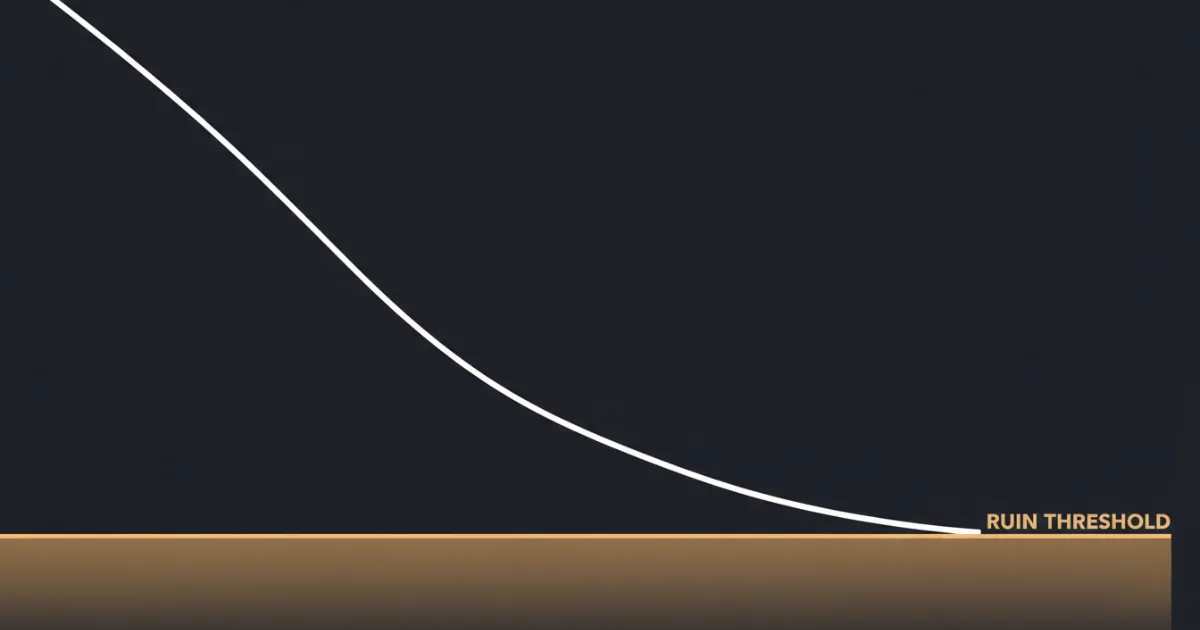
Risk of ruin is the probability that your account will drop to a point where you stop trading. That threshold, called the ruin point, isn't always a zero balance. Most traders define it as a 20% to 30% drawdown. That's the level where recovery shifts from difficult to unrealistic. Each trade moves that probability up or down, depending on your win rate and how much you risk per trade. Your capital cushion (the gap between current balance and ruin point) determines how many losses you can absorb.
Key Takeaways
- Risk of ruin is the probability a trader's account will decline to a predefined ruin point: the drawdown threshold where continuing the strategy becomes unrealistic.
- Sizing risk at 1% to 2% per trade produces near-zero ruin probability for any positive-expectancy system.
- Perry Kaufman's formula shows that reducing per-trade risk from $1,000 to $100 on a $10,000 account (same 20% ruin threshold) cuts ruin probability from 8.4% to near zero. The formula uses an exponent: each added capital unit multiplies the reduction.
- Drawdown compounds against recovery. A 50% loss requires a 100% gain to break even from a smaller capital base.
- Fixed fractional sizing, which means risking a fixed percentage of current account balance per trade, scales risk down during drawdowns and keeps ruin probability flat as the account shrinks.
What Is Risk of Ruin in Trading?
Risk of ruin is the statistical probability that your account will decline to a level where you stop trading. That level is the ruin point: a specific drawdown threshold you define before risking a dollar. It doesn't have to mean zero. Most traders set it between 25% and 50% of account equity. Reach it, and you stop trading and reassess.
Two traders can run identical strategies with identical win rates and face very different outcomes. The system is identical. Position sizing alone determines which trader survives the streak.
Research from Barber and Odean on individual investor performance documented that retail traders underperform benchmarks through excessive trading and poor risk discipline. Account blowups don't offer a second attempt at the same strategy.
What Drives Your Ruin Probability?
Three variables control your ruin probability.
Win rate (edge). Edge is your probability of a winning trade. A 55% win rate with 1:1 risk-to-reward represents a positive-expectancy system. A 40% win rate needs larger average wins to compensate. Lower edge means more frequent losing streaks, which increases ruin probability at any given risk level.
Risk per trade. This is the percentage of your account at risk on a single trade. Risk 1%, and 10 straight losses cost you about 10% of your account. Risk 10%, and the same streak takes 65%. Each loss reduces the base from which the next loss is calculated, so losses compound faster than the percentage alone suggests.
Capital units. Capital units is the number of per-trade risk increments between your current balance and your ruin point. If ruin is a 20% drawdown on a $10,000 account ($2,000), and you risk $100 per trade, you have 20 capital units before hitting the ruin point. More units means more cushion. Both a larger account and smaller per-trade risk increase this number.
These three interact. A high win rate tolerates a higher risk per trade at acceptable ruin probabilities. A low win rate demands tighter sizing, or a high reward-to-risk ratio, to produce positive expectancy over time.
Losing streaks longer than traders expect are normal. At a 55% win rate, you lose 45% of all trades. A streak of six consecutive losses carries a 0.8% probability on any given six-trade sequence. Over hundreds of trades, that streak will appear. Position sizing determines whether you're still in the game when it does.
The Risk of Ruin Formula
Perry Kaufman published the most widely cited risk of ruin formula in Trading Systems and Methods:
RoR = ((1 - Edge) / (1 + Edge)) ^ Capital_Units
Where:
- Edge = your win probability (e.g., 0.55 for a 55% win rate)
- Capital_Units = ruin threshold in dollars divided by per-trade risk in dollars
A worked example: $10,000 account, 55% win rate, ruin point at 20% drawdown ($2,000), $100 risk per trade.
Capital_Units = $2,000 / $100 = 20
RoR = ((1 - 0.55) / (1 + 0.55)) ^ 20 = (0.290) ^ 20 ≈ 0.0000000018%
Near zero. Change the risk to $1,000 per trade:
Capital_Units = $2,000 / $1,000 = 2
RoR = (0.290) ^ 2 ≈ 8.4%
Same strategy, same account, different sizing: ruin probability jumps from near zero to 8.4%. The table below shows how ruin probability moves with per-trade risk, holding everything else constant.
| Risk Per Trade | Capital Units | RoR (55% win rate) |
|---|---|---|
| $100 (1%) | 20 | ~0.000000002% |
| $200 (2%) | 10 | ~0.0004% |
| $500 (5%) | 4 | ~0.71% |
| $1,000 (10%) | 2 | ~8.4% |
| $2,000 (20%) | 1 | ~29.0% |
At 20% risk per trade, about 1 in 3 traders running this system eventually hits the ruin point, despite a 55% win rate.
Kaufman's formula uses win probability as the sole measure of edge. Reward-to-risk ratio isn't captured. For a more complete picture that accounts for both, the Risk of Ruin Calculator runs a simulation across thousands of trade sequences using your actual reward-to-risk ratio inputs.
Why Drawdown Compounds Against You
Losing 20% of your account doesn't require a 20% gain to recover. The loss starts from a smaller base, so the return needed to break even is always larger than the drawdown percentage.
| Drawdown | Return Needed to Break Even |
|---|---|
| 10% | 11.1% |
| 20% | 25.0% |
| 25% | 33.3% |
| 33% | 50.0% |
| 50% | 100.0% |
| 75% | 300.0% |
A trader who drops from $20,000 to $10,000 needs a 100% return to get back to square one, from a halved capital base, while keeping position sizes smaller to avoid ruin probability rising again. The 50% drawdown removes capital and the compounding base that would have funded recovery.
Van Tharp addresses this in Definitive Guide to Position Sizing: account survival depends on keeping drawdowns within a recoverable range, which in practice means fixing risk per trade as a percentage of current equity rather than a fixed dollar amount.
The 25% ruin point has a specific mathematical basis. A 25% drawdown requires a 33% return to recover. That's difficult but achievable for a positive-expectancy system given enough trade sequences. A 50% drawdown requires 100%, from half the capital base, with sizing that must stay smaller throughout. Each step deeper into drawdown changes the recovery math.
How to Keep Your Risk of Ruin Near Zero
Risk 1% to 2% per trade. At 1% risk with a 55% win rate and a 20% ruin threshold, you have 20 capital units and a ruin probability near zero. At 2%, you have 10 capital units and a ruin probability under 0.001%. Risk 1% to 2% and ruin probability across any realistic losing streak stays negligible.
Use fixed fractional sizing. Fixed fractional sizing means risking a fixed percentage of current account balance on each trade. When the account drops to $8,000 after a drawdown, 1% is $80, not $100. Position size contracts during losing streaks, which is exactly when smaller size matters. A Martingale strategy inverts this: it increases size after losses, compounding both drawdown speed and ruin probability. Fixed fractional sizing is the structural counter to that pattern.
Set your ruin point before you start. The ruin point isn't a vague concept. It's a specific number: 20%, 25%, 30%. When that level is reached, stop trading the strategy, reduce size, and review. Without a defined ruin point, traders make reactive sizing decisions during drawdowns. That's when judgment is worst and position sizes tend to grow.
Know your positive expectancy before sizing up. The Kaufman formula treats edge as a binary win/loss probability. A 45% win rate with a 2.5:1 reward-to-risk ratio carries positive expectancy, but a lower win rate requires more trade sequences before the edge expresses itself. Undersizing to match a small account and a lower win rate keeps the system alive long enough to perform.
The Kelly Criterion gives the optimal fraction of capital to risk per trade, calculated from win rate and reward-to-risk ratio. Most traders use half-Kelly or less to reduce variance while maintaining positive expected growth. The Position Size Calculator handles the per-trade sizing calculation: enter account size, stop distance, and target risk percentage.
Check Your Own Numbers
The Kaufman formula gives a theoretical estimate under simplified assumptions. For a more precise picture that accounts for reward-to-risk ratio and runs across thousands of simulated trade sequences, use the Risk of Ruin Calculator. Enter win rate, average reward-to-risk ratio, and risk per trade as a percentage. If the output exceeds 5%, reduce position size until it doesn't.
Most accounts that blow up got there through a sequence of wrong sizing decisions, not one catastrophic trade.