Revenge trading is raising your risk after a loss to win the money back.
Three losses into the morning, a setup that pays three times the risk shows up, and your usual 2% suddenly looks too small. It is the same setup you take every week. Only the morning changed, and you are letting the losses set your size.
Poker players call the state behind it tilt, and traders borrowed the word: bigger trades after losses, faster trades, setups you would normally skip.
The free lesson on this page gives you one bad morning to trade. You choose only how much to risk on each trade, so you can see what the losses do to that one number.
What happens in the lesson?
You take five trades in a row from a $10,000 account. For each one you risk 1%, 2%, 5% or 10% of it.
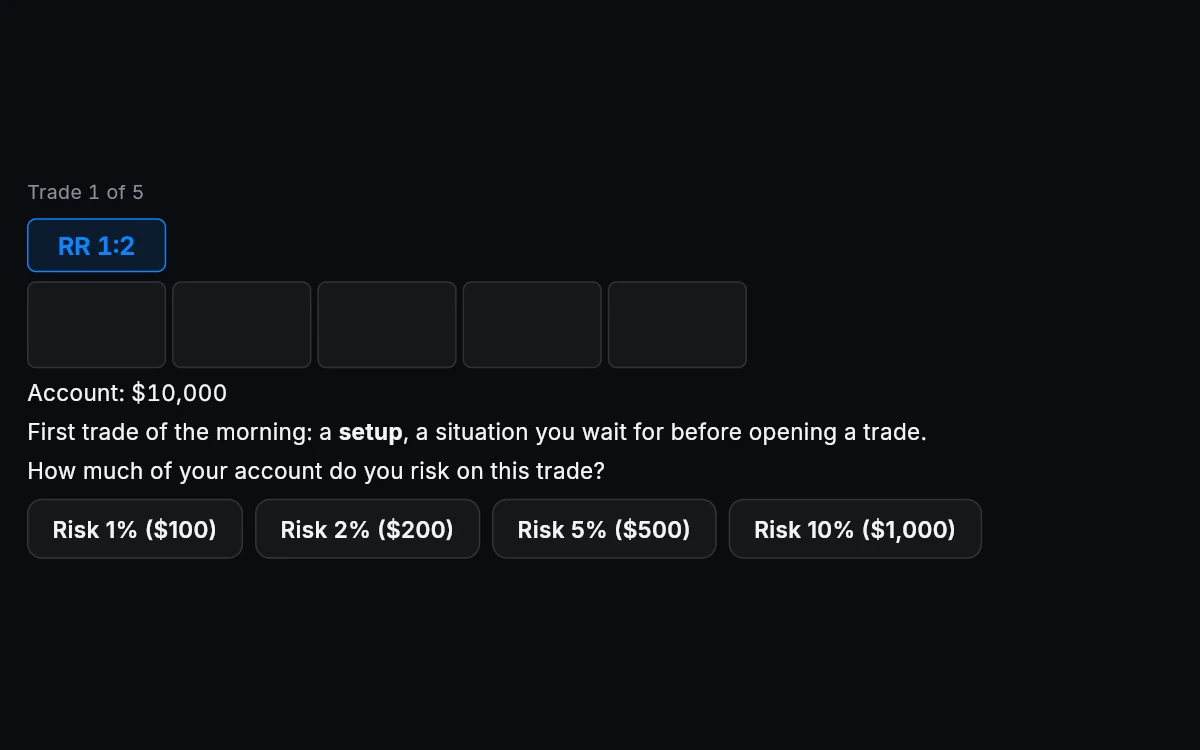
The trades are written in advance:
| Trade | A win pays | Result |
|---|---|---|
| 1 | 2× the risk (1:2) | Loss |
| 2 | 1.5× | Loss |
| 3 | 1× | Loss |
| 4 | 3× | Loss |
| 5 | 2× | Win |
You do not know that while you pick. All you see is the account going down. By trade 4 it is three losses in, and one win at three times a bigger risk would win back the whole morning.
That is the trade where the pull is strongest. At the end, the lesson shows whether your risk rose after the losses, fell, or stayed the same.
Do traders really take more risk after losing?
Yes, professionals included. Joshua Coval and Tyler Shumway studied proprietary traders at the Chicago Board of Trade. "Our traders appear highly loss-averse, regularly assuming above-average afternoon risk to recover from morning losses," they wrote in the Journal of Finance (2005).
Some people react the other way. Alex Imas found that once a loss is realized, closed and done, people avoid risk. When the same loss is still open on paper, they take on more (American Economic Review, 2016).
| After a loss | What people tend to do | What it can cost |
|---|---|---|
| The loss is still open | Take more risk to get it back | One more loss, at a bigger size |
| The loss is closed | Take less risk, skip trades | Setups that would have paid |
How do you stop revenge trading?
Set your risk per trade before the session, when no loss is on the screen, and keep it after a loss. A setup you would risk 2% on gets 2% after three losses too.
Write a daily stop down in advance. After a set number of losses in a row, say three, or a set dollar loss, you are done for the day. The daily loss limit guide shows how to pick the number.
Take a break after a loss. Time between the loss and the next decision lets you judge the next trade on its own.
Keep the same percentage on every trade. As the account shrinks, each loss shrinks with it, and the lesson on how much to risk shows why that matters.
A win is never due. Each trade has the same chance, whatever came before it.
How do you know you are on tilt?
From what you do, rarely from how it feels. In the moment, tilt feels like the obvious way to fix the day.
The signs:
- Your size after a loss is bigger than your usual size.
- Trades come faster than your setups do.
- You take a setup you would pass on during a fresh morning.
Putting a name to the feeling helps a little. The game in the Tradicted app has an optional check-in behind its brain button, and one of the moods you can pick is "Want it back".
Key points
- Revenge trading is raising your risk after a loss to win it back. Your size starts following the losses.
- Chicago Board of Trade traders took above-average afternoon risk after morning losses (Coval and Shumway, 2005).
- After a closed loss, many people do the opposite and take less risk (Imas, 2016).
- Set your size and a daily stop before the session, and keep both after a loss.
Press Start above and trade the morning. Lesson 3 covers the urge to buy after price has already shot up.